
Was He Really 2.5? The Science of Aging Whitetail Deer
Insider Staff / 936 Insider | November 1, 2026
On October 31, 2026, we posted a story about a large buck found deceased in the median of the Highway 59 Bypass in Livingston. The feedback came in fast. Most commenters felt the deer was older than Texas Parks and Wildlife’s reported 2.5-year estimate, so we started looking at what the research says about aging a deer by its teeth.
The honest answer is that nobody can say for sure without a lab. And even then, it is not a perfect number. Here is what the research actually shows.
How biologists age a deer
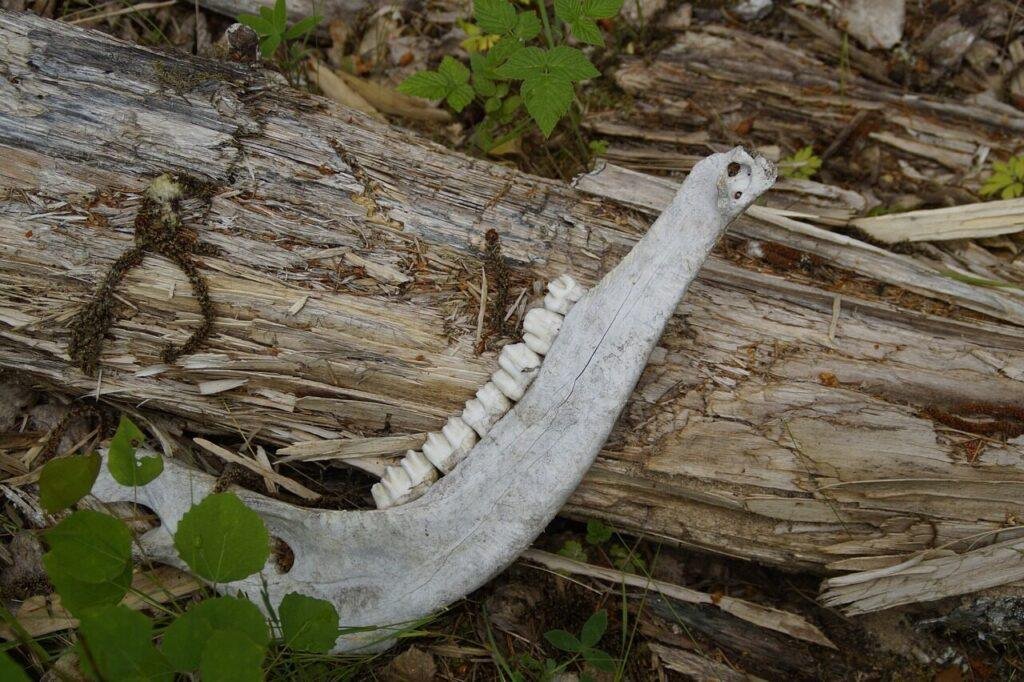
The usual method is called tooth replacement and wear, or TRW. A biologist opens the deer’s lower jaw and looks at the back teeth. Young deer have baby teeth that get replaced on a schedule, so a fawn or yearling is easy. Once a deer is older, biologists have to judge how worn the molar enamel is.
A researcher named C.W. Severinghaus, a New York State wildlife biologist, documented the method in 1949. He built it from a large collection of jaws turned in at hunter check stations across New York, including deer whose real ages he already knew. He saw two useful patterns. Young deer replace their baby teeth on a strict biological schedule (the same way human kids do), so you can read a fawn or yearling’s age just by looking at which teeth are in. Older deer have no clock like that, but their cheek teeth wear down a little more each year, exposing brown dentine next to the white enamel. He photographed and described a reference jaw for each age class and published the set in the Journal of Wildlife Management. Seventy-seven years later, state biologists still compare field jaws against that same reference.
A short timeline: when the other methods came in
The other three methods came later, each one answering a different need.
Cementum annuli — 1966 for whitetails. F.F. Gilbert published the first paper applying the growth-ring method to white-tailed deer in the Journal of Wildlife Management, Vol. 30, No. 1. He showed you could count seasonal rings in the root of a deer’s front incisor, the same way you count rings in a tree. Three years later, in 1969, Gary and Judy Matson opened a small wildlife lab in Milltown, Montana. Gary is credited with pioneering commercial cementum age analysis in the United States. That lab is now Matson’s Laboratory, and state agencies and hunters have been sending teeth there for decades.
Body-shape judging — popularized in the 1990s and 2000s. The Quality Deer Management Association was founded in 1988 (today’s National Deer Association). Through the 1990s and 2000s, QDMA and researchers at the Mississippi State University Deer Lab published hunter guides for aging live bucks by belly sag, neck size, back line, and face length. It is not a lab method, and it does not give an exact year. It is a trained eye on a live deer, a trail cam photo, or a dead deer.
Trail cam history — practical by the mid-2000s. Digital trail cameras became cheap and reliable around 2005. Within a few years, hunting properties built up multi-year photo libraries. If a buck shows up on cam in 2024 and the same buck is dead in 2026, his minimum age is 3.5. He cannot be 2.5. It is the only aging method a hunter can do without a lab, a jaw, or a trained eye.
What large studies have found
Three major peer-reviewed studies have tested the method. They used real deer whose ages were already known from birth records, ear-tagged fawns, or paired lab analysis. Together, they tested the method on thousands of deer, not a handful.
Jacobson and Reiner, 1989 (Journal of the Southeastern Association of Fish and Wildlife Agencies). This is the biggest field test ever published on southeastern deer. The researchers took 98 jawbones from deer whose ages were already known and ran them through 55 state biologists for 5,390 total age estimates. Only 62.6 percent of those estimates matched the deer’s real age. The method got young deer right most of the time, but on deer older than 3.5 years it produced ages lower than the real age.
Samuel and colleagues, 2014 (Wildlife Society Bulletin). This study ran paired comparisons on 1,261 adult white-tailed deer from Wisconsin and Illinois. Each jaw was aged two ways: once by the field TRW method and once by lab cementum annuli. The misclassification was “substantial,” and the direction of the error depended on sex and age. For male deer, the finding was clear: the method tends to return ages below the true age on young bucks and above the true age on old bucks.
Adams and Blanchong, 2020 (PLoS ONE). This study compared TRW ages to lab cementum annuli ages on 1,292 Iowa deer. The methods agreed 80 percent of the time for yearlings and 78 percent for deer aged 3 and older. The worst age class was 2-year-olds, where the two methods agreed only 65 percent of the time.
That is the Livingston buck’s exact age class.
What can tilt an age estimate?
Both methods have known weak spots. The field method depends on how fast the teeth wore down in life, and that changes with soil, diet, sex, and the human doing the reading. The lab method depends on seasonal growth rings in the tooth root, and those can be faint, false, or ground away. The research below is organized by which method each variable affects. We also must consider what role habitat, high-fence versus free-range, plays in the physical development and rate of aging.
Research at Texas Parks and Wildlife’s Donnie E. Harmel White-tailed Deer Research Facility at Kerr WMA, a long-running closed-herd study of native Texas whitetails, found that nutrition drives both body weight and antler development. Bucks on a continuous 16 percent protein diet put on the most body weight. Bucks that cycled through drought-level diets, which TPWD called “swing” deer, grew good bodies and antlers in good years and poor ones in stress years. Antler size climbs each year until peak growth at 5 to 7 years, then falls off after 8.
That matters for the Livingston buck. He was a free-range East Texas deer, eating what the woods gave him, through the late-summer dry stretch of 2026. A high-fence buck of the same age, on a free-choice protein feeder and a managed browse rotation, often carries a bigger body and heavier rack earlier. Same age on paper, different animal in the field. The reverse is true too. A free-range buck whose body comes in late because of drought will not look as mature as his years, which is one more way a trained eye can miss his age by a season.
Has anyone tested jaw aging in supplementally fed deer?
Not on true small-pen, pellet-only high-fence deer, no, but close. The Caesar Kleberg Wildlife Research Institute at Texas A&M-Kingsville ran a 134-deer known-age study on bucks 2.5 years and older, published by Foley and colleagues in Wildlife Research in December 2021. Tooth wear was 43 to 51 percent accurate to the exact year, and 87 percent accurate within one year. Cementum annuli was 60 to 62 percent accurate to the exact year, and 93 percent accurate within one year. A separate CKWRI study by Dr. Randy DeYoung on roughly 7,000 harvested deer from the King Ranch, 2000 to 2014, looked at whether supplemental feeding shifted the jaw-wear reading. “It didn’t have much influence,” DeYoung said. The reason: fed deer still eat native forage, so grit still reaches the molars.
The honest gap: nobody has published a jaw-aging accuracy study on small-pen, pellet-only, no-browse deer. If that extreme ever got tested, you would expect the softest reading of all. But on a working Texas ranch with a free-choice protein feeder, researchers say the jaw-wear number doesn’t move by a full year.
Is the jaw method the only way?
No. There are four ways to age a deer. One is the field jaw method TPWD uses. The others are more accurate but take more time, money, or luck.
Cementum annuli lab work is what Matson’s Laboratory in Montana does, and it is the lab most state agencies send teeth to for research deer. It is the only way to settle an exact age on a deer that is already dead.
For a buck as photographed as this one, the trail-cam-history method could still answer the question for free, if any hunter in the area has photos of this same deer from a prior year. One matched sighting from the 2025 season would prove he was older than 2.5.
What hunters should remember?
A big-bodied deer with heavy antler mass is not automatic proof of maturity. Genetics, nutrition, and the time of year all change how a buck looks in October. Properties with good food and good genes can grow large racks on younger deer. It is rare, but it happens.
TRW is the standard method every state wildlife agency uses, including TPWD. It is standard because it is cheap, fast, and works well enough for population management across thousands of deer a year. It isn’t meant to be the final word on one special animal.
If you are trying to put an age on a buck you shot or found, body shape helps more than antler size. A heavy, swayed back, a pot belly, loose skin on the neck, and a long face are signs of an older deer. A tight, athletic body with square shoulders is usually a younger deer, no matter how big the rack is. (National Deer Association field aging guide.)
The Insider’s read: 2.5 – 3.5 years old
The bottom line
The 2.5-year estimate came from the field method every state uses. Hunters pushing back on it are not wrong to ask. Thousands of peer-reviewed test cases show the method tends to under-age young bucks, and that 2-year-olds are the hardest age class for the method to call right. The only way to know for sure is a lab test on the tooth, and that may or may not happen with this deer. We reached out to local TPWD officials to ask about any laboratory testing, score, and official cause of death, and we’ll report any new information.
Either way, East Texas lost a special buck, and the Highway 59 Bypass is still as dangerous as it was Saturday morning.
Texas general whitetail season opens in the North Zone on November 7. Drive careful.
Related reading on 936 Insider:
- Big Buck Down: Massive 2.5-Year-Old Buck Found Dead on Highway 59 Bypass in Livingston
- Deer Season Opens Nov. 7 in East Texas: Dates, Rules and a Reminder to Secure Your Load
- The Deer Camp — East Texas hunting hub
- Polk County, Texas Today — latest local news
Frequently asked questions about aging whitetail deer
How accurate is jaw tooth-wear aging on deer?
It depends on the age class. In a 2021 known-age Texas study (Foley et al., 134 bucks), tooth wear was correct to the exact year 43 to 51 percent of the time, and within one year 87 percent of the time. Earlier work by Jacobson and Reiner (1989) across 55 biologists and 5,390 estimates found 62.6 percent exact-year accuracy on southeastern deer.
Can supplemental feeding change a deer’s jaw-wear age?
By a little, but not by a full year. CKWRI’s Dr. Randy DeYoung said feeding “didn’t have much influence” in the King Ranch comparison, because fed deer still eat native forage. No published study has tested small-pen, pellet-only deer at the extreme end.
What is cementum annuli aging?
A lab method that counts the seasonal growth rings in the root of a deer’s front incisor, the same way you count the rings in a tree. In the Foley 2021 known-age study, cementum annuli was correct to the exact year 60 to 62 percent of the time, and within one year 93 percent of the time.
How much does cementum annuli lab aging cost?
Matson’s Laboratory in Milltown, Montana, the lab most state agencies use, charges a per-tooth fee and takes a few weeks to return results. Check their site for current pricing.
What is the best way to age a dead buck?
Cementum annuli is the most accurate single method on a jaw you cannot match to prior trail-cam photos. If you do have prior-season photos of the same buck, that is the only free way to prove a minimum age without a lab.
Sources
- Severinghaus, C. W. (1949). Tooth development and wear as criteria of age in white-tailed deer. Journal of Wildlife Management, 13(2), 195–216.
- Gilbert, F. F. (1966). Aging white-tailed deer by annuli in the cementum of the first incisor. Journal of Wildlife Management, 30(1), 200–202.
- Jacobson, H. A., & Reiner, R. J. (1989). Estimating age of white-tailed deer: Tooth wear versus cementum annuli. Proceedings of the Southeastern Association of Fish and Wildlife Agencies, pp. 286–291.
- Samuel, M. D., Storm, D. J., Rolley, R. E., Beissel, T., Richards, B. J., & Van Deelen, T. R. (2014). Estimating ages of white-tailed deer: Age and sex patterns of error using tooth wear-and-replacement and consistency of cementum annuli. Wildlife Society Bulletin. DOI: 10.1002/wsb.457
- Adams, D. M., & Blanchong, J. A. (2020). Precision of cementum annuli method for aging male white-tailed deer. PLoS ONE, 15(5), e0233421.
- Penn State Deer-Forest Study, “Age and Antlers” research series.
- U.S. Geological Survey, “Estimating ages of white-tailed deer: age and sex patterns of error using tooth wear and replacement.”
- East Foundation, Wildlife Research Vol. 49, Issue 3, “Accuracies and biases of aging white-tailed deer in semiarid regions.”
- Wyoming Game & Fish Department, Handbook of Biological Techniques, Chapter A05 (Aging Techniques).
- Clemson University Extension, “A Key for Aging White-tailed Deer Using the Tooth Replacement and Wear Technique.”
- Missouri Extension Guide G9484, “Aging White-tailed Deer.”
- PubMed Central article PMC 10381091 (cementum annuli accuracy and climate).
- Alabama Cooperative Extension, ANR-1412, “Collecting Data to Manage White-tailed Deer.”
- Caesar Kleberg Wildlife Research Institute, Inside Deer Research newsletter, Fall 2010.
- Matson’s Laboratory, “About Us” — founding history, Milltown, Montana, 1969.
- National Deer Association / Quality Deer Management Association, hunter aging guides (1990s–2000s).
- Mississippi State University Deer Lab, body-shape aging materials.
- Texas Parks and Wildlife Department, Donnie E. Harmel White-tailed Deer Research Facility, Kerr WMA, research summary (nutrition, genetics, and antler development in native Texas whitetails; 1974–present).