
The Verdict Is In: The Livingston Buck Was Young
Insider Staff / 936 Insider | November 6, 2026
Estimated reading time: 5 minutes
Table of contents
This is a follow-up on the massive Livingston buck found dead on the U.S. 59 Bypass October 31 story where hunters pushed back on Texas Parks and Wildlife’s 2.5-year age estimate of the deer. Our companion piece on the science of aging whitetail deer landed at 2.5 to 3.5. The game biologist has gone on the record with his findings.
What the biologist found
A Texas Parks and Wildlife Department (TPWD) game warden who prefers to remain anonymous and has declined to comment recovered the deer. A TPWD wildlife game biologist, Chris Gregory, examined the lower jaw and emailed us the finding. From his note:
“We looked it over and then looked in its mouth to determine an age and were equally surprised to see a two-cusped third premolar, very little dentine exposed on the first molar and almost no dentine exposed on the second and third molar. The other side of the lower jaw looked the same.”
In plain English, that is three young-deer markers on the same jaw.
- Two-cusped third premolar. Fawns and yearlings have a three-cusped baby tooth in that spot. By 2.5, the permanent two-cusp version replaces that baby tooth. Three cusps means 1.5 or younger. Two cusps means 2.5 or older.
- Very little dentine on the first molar. Dentine is the darker tissue under the white enamel. As a deer chews over its life, enamel wears off and dentine shows. Very little means very little wear.
- Almost no dentine on the second and third molar. Same story, further back in the mouth. The deer had barely used the chewing surface on those teeth.
The verdict
Per the TPWD field guide to aging whitetail deer (authored by TPWD wildlife biologists Alan Cain and Mike Wallace), a 2.5-year jaw shows sharp, pointed lingual crests on all molars, a freshly erupted two-cusp third premolar, and enamel wider than dentine on teeth 4, 5, and 6. The markers Chris Gregory described — two-cusp P3 and minimal dentine wear on all three molars — match that pattern.
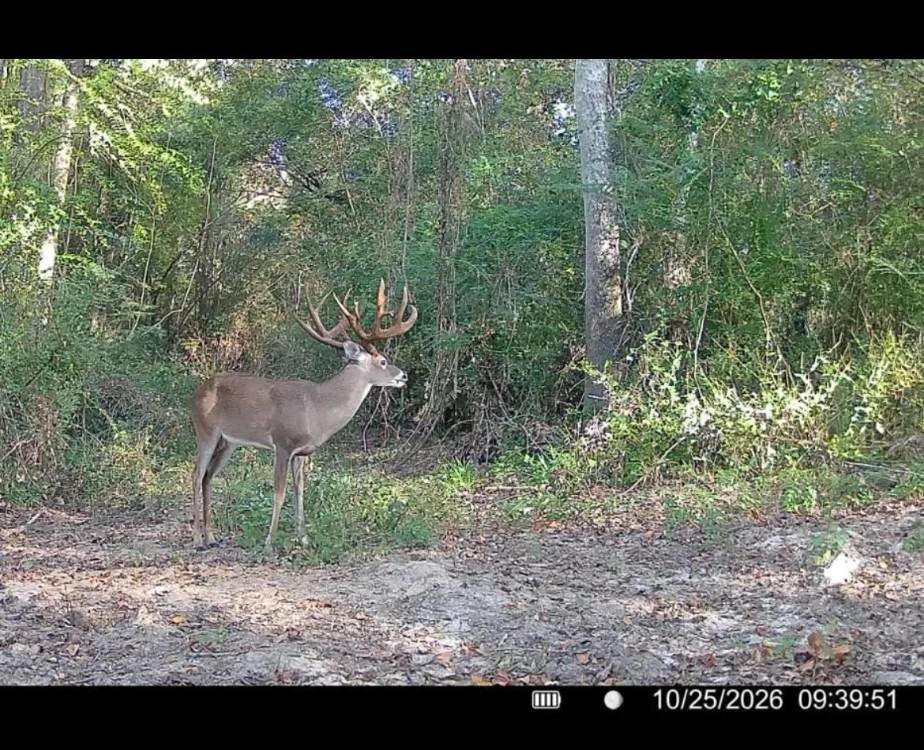
The rack was uncharacteristically mature for a deer of this age in a free-range environment in East Texas. The mouth and body were not. TPWD’s call stands: a 2.5-year-old buck found outside any high-fence operation, wearing a rack most of his cohort won’t grow for another three seasons.
Cause of death confirmed
TPWD has also confirmed the buck died of injuries consistent with being struck by a motor vehicle, closing out one of the open questions from our earlier science piece. The deer was found in the median of the Highway 59 Bypass on the morning of October 31. Chris Gregory also noted that it is illegal in Texas to possess a deer you have not killed yourself, which is why TPWD takes custody of road-killed and found deer.
What else could narrow the age?
The field jaw method isn’t the only way to age a deer. We walked through the full set in the companion piece, but here’s where each one stands for this buck:
- Cementum annuli: the lab method that slices a tooth and counts seasonal growth rings. It’s the most accurate single method on a dead deer outside of photographic documentation of the deer over time. As of this report, there are no plans for this testing.
- Trail cam history: If any hunter in the area has a dated photo of this same buck from the 2025 season or earlier, that alone proves he was older than 2.5. Send any photo you think might be him through The Deer Camp, or email it to admin@936insider.com.
- Body shape: we covered this in the companion piece and landed at 2.5 to 3.5. Chris Gregory’s jaw markers sit at the young end of that range.
Where did he come from?
He was found outside any high-fence operation, but that is not the same as being born and raised in the wild. For a 2.5-year-old buck to carry this frame on open range in a dry East Texas year is rare, so the honest list of possibilities stays open:
- His mother was a pregnant doe that slipped out of a high-fence breeding operation, and he’s genetically a managed-herd deer born on the outside.
- He escaped a high-fence operation himself earlier in life.
- He escaped during transportation between facilities.
- He really is a native East Texas buck with a rare combination of genes and conditions.
Without other pictures of the deer from earlier that would indicate he was managed, a tissue sample or an ear tag, no one can say which.
May your arrows be sharp, your powder dry, your gun clean and your aim true. Stay safe and happy hunting!
Key Takeaways
- The Texas Parks and Wildlife Department confirmed the Livingston buck is 2.5 years old based on dental analysis.
- TPWD documented signs of young-deer markers in the buck’s jaw, indicating its age category.
- The buck died from injuries consistent with being struck by a vehicle, as confirmed by TPWD.
- Questions about the buck’s origin remain: it could have been from a high-fence breeding operation or a native deer with unique genetics.
- The Deer Camp opens for the hunting season on November 7, offering updates and stories from East Texas.
The Deer Camp is open
Gun season opens Saturday, November 7, and The Deer Camp is live — big-buck trail cam shots, hunter stories, taxidermy spotlights, and camp traditions from East Texas.
Related reading on 936 Insider
- Big Buck Down: Massive 2.5-Year-Old Buck Found Dead on Highway 59 Bypass in Livingston
- Was He Really 2.5? The Science of Aging Whitetail Deer
- Deer Season Opens Nov. 7 in East Texas: Dates, Rules and a Reminder to Secure Your Load
- The Deer Camp — East Texas hunting hub
- Share Yours — Submit to The Deer Camp
- Polk County, Texas Today — latest local news
- What’s happening across the 936 — events calendar
- List your East Texas business — free